Article summary
- Commercial solar has evolved from a sustainability add-on to proven infrastructure, with typical paybacks now within two to four years.
- A solar system is ultimately tailored around the client’s objectives, whether that be offsetting existing electricity usage, futureproofing for planned electrification projects, or balancing both.
- Distribution Network Operator (DNO) approval, which means formal permission from the company that manages the local electricity distribution network, is often the largest programme risk on a commercial project. Engaging early protects timelines and budget.
In this guide
What kind of return you can expect
Whether your building is suitable
Performance and financial returns
Planning permission and compliance

Energy prices remain volatile, and the ability to generate power on-site has become a serious lever for cost control.

Why businesses are turning to solar in 2026
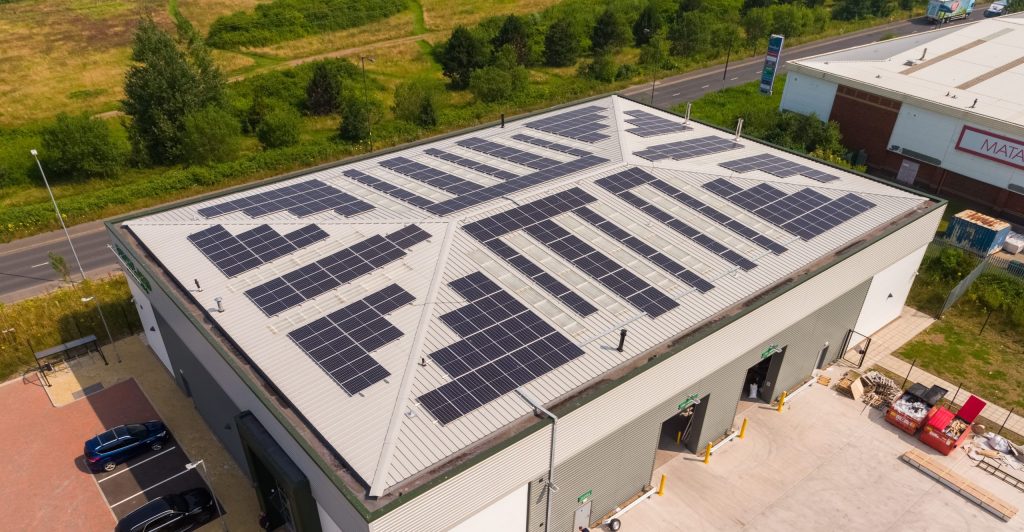
Across UK commercial property, manufacturing and logistics, we are seeing solar treated as infrastructure rather than a green add-on. It is now widely accepted as a low-risk investment that gives long-term cost certainty and protects against future price spikes.
Sustainability expectations have also matured. Customers, supply chains, lenders and stakeholders increasingly expect measurable progress, and solar offers a direct route to carbon reduction that supports ESG (Environmental, Social, and Governance) reporting and disclosure requirements.
There’s a timing factor, too. After years of decline, panel prices are rising1. For businesses still considering solar, this strengthens the case for acting sooner.
In short, on-site solar:
- Provides long-term cost certainty and protection from energy market volatility.
- Reduces exposure to grid constraints and future price spikes.
- Delivers measurable carbon reduction to support ESG targets.
- Improves building value and long-term asset performance.
- Acts as a low-risk, infrastructure-grade investment.


How solar actually works
Solar panel systems contain solar cells that convert daylight into electricity.
That electricity is used on-site first, reducing the volume of power your business needs to import (buy) from the grid. Any surplus electricity can be exported (sent) back to the grid, depending on how the system has been designed and whether the local network can accept it.
The principle is straightforward. The value of a system lies in how well it aligns with how your site actually uses energy.
What kind of return you can expect
Return on investment depends on three main variables: your usage profile, the site layout, and the amount of energy generated that is consumed on-site. A few principles apply consistently:
- Systems are designed to offset purchased electricity first.
- Export is a secondary benefit, not the primary case.
- A long asset life means decades of continued savings after payback.
In other words, the strongest financial returns come from displacing power you would otherwise have bought.
How we size a system properly
System design isn’t one-size-fits-all. We size systems to your business’s actual energy needs, not just roof capacity. Unless asked to maximise coverage, we design for the strongest commercial return.
The key factors we consider include:
- Load profile across the working day and year.
- Roof orientation, pitch and structural condition.
- Available space and shading.
Maximising on-site consumption is what delivers the strongest financial return for businesses.
Whether your building is suitable
Most commercial roofs and many adjacent land areas can support solar. Suitability depends on structure, orientation, shading, and existing electrical infrastructure.
We assess this in stages: an initial check confirms feasibility, and a detailed survey validates the design before installation. The goal is to identify issues early.
Performance and financial returns
Payback periods have shortened considerably over recent years. We now commonly see businesses recover their investment within two to four years, depending on the usage profile and how the system is operated.
After payback:
- Systems continue to generate predictable savings for 25 years or more.
- Export payments can provide an additional revenue stream, where the network allows.
- The largest long-term value comes from the electricity that the business avoids buying.
These predictable, long-term savings give commercial solar its infrastructure-like investment profile.


Planning permission and compliance
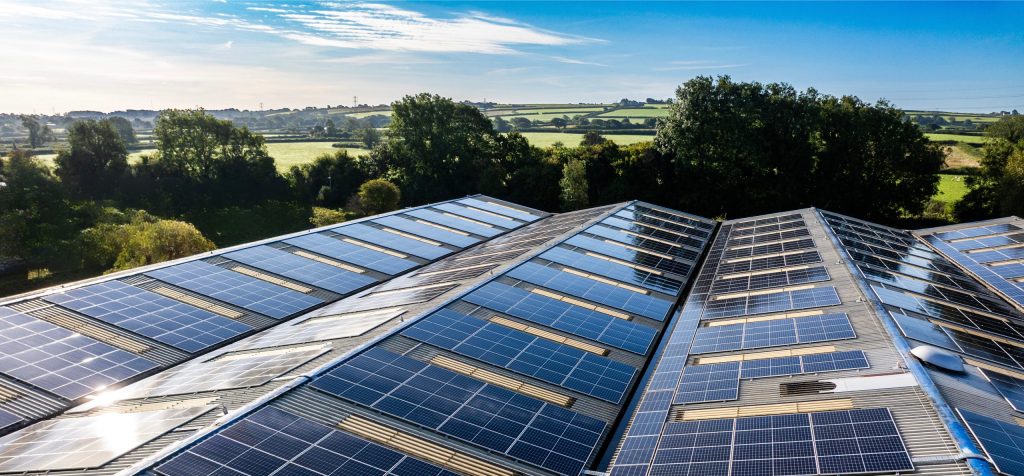
Whilst many commercial rooftop solar installations benefit from permitted development rights under Schedule 2, Part 14, Class J of the Town and Country Planning (General Permitted Development) (England) Order 2015, this does not necessarily mean a project can proceed without formal planning engagement.
In practice, a detailed planning review is still required to assess whether the proposed development satisfies the relevant limitations and conditions of the legislation, including matters such as roof positioning, visual impact, listed status, conservation designations, and site-specific constraints. Depending on the nature and location of the development, a formal prior approval application and/or lawful development assessment may still be required before works can lawfully commence.
At Ineco Energy, we undertake detailed upfront planning and compliance reviews as part of our project development process to help identify potential constraints early, reduce programme risk, and provide clients with greater certainty prior to installation. This proactive approach helps support smoother project delivery, informed decision-making throughout the development process, and mitigates any compliance issues now or in the future.
Understanding DNO approval
Your Distribution Network Operator (DNO), the company responsible for managing the local electricity distribution network, must assess and approve any generating system connecting to the grid in accordance with the Electricity Act 1989 (as amended) and the relevant Engineering Recommendations, including G98, G99 and, where applicable, G100 export limitation requirements.
As part of this process, the DNO assesses local network capacity and determines whether the system can operate under unrestricted, limited, or restricted export conditions.
For commercial solar projects, DNO approval is often one of the most significant programme risks, with approval timelines and network constraints that can materially affect project viability, system sizing, programme sequencing, and energisation dates. Engaging with the DNO early in the development process is therefore critical to reducing programme risk and maintaining project momentum.
Tax and capital allowances
Commercial solar installations can typically qualify for capital allowances as plant and machinery. Subject to eligibility and individual tax circumstances, businesses may currently benefit from the Annual Investment Allowance (AIA), which provides up to 100% tax relief on qualifying expenditure of up to £1 million per accounting period.
Where expenditure exceeds the AIA threshold, qualifying solar assets may also benefit from first-year allowances and ongoing writing-down allowances under the relevant capital allowance regime.
As tax treatment depends on the specific project structure and business circumstances, we always recommend seeking advice from a qualified tax advisor or accountant.
What happens after installation
Solar isn’t a fit-and-forget asset. Like any major investment, it benefits from ongoing care to extend life and protect returns.
Like any major infrastructure investment, it benefits from ongoing monitoring, inspection, and maintenance to protect long-term performance, safety, system lifespan, and commercial returns. Monitoring systems track generation and system health in real time, helping identify faults, underperformance, or abnormal behaviour early. Routine inspections, testing, and preventative maintenance help to maintain safe operation, preserve manufacturer warranties, support compliance obligations, and identify issues such as damaged components, excessive soiling, water ingress, or bird-related activity before they escalate. This is why we treat operations and maintenance as part of the asset lifecycle itself, not an optional extra after installation.
A note on monitoring:
If you don’t monitor it, you can’t measure it!
Our dedicated and professional team will complete a full system handover and set you up on the SolarEdge inverter monitoring portal.
The Monitoring portal offers our customers full visibility into their Solar Array’s power generation and financial performance, and provides automatic alerts for system faults, so they can be addressed at the module level, greatly reducing the need for costly maintenance and downtime.

Whether panels need cleaning
It depends on the environmental conditions at the site, which can vary significantly from one location to another. In most cases, we treat panel cleaning as reactive maintenance, with cleaning only undertaken where monitoring or inspections identify that excessive soiling, bird activity, or other environmental factors are materially affecting performance or creating operational risks.
That said, some clients choose to proactively include panel cleaning within their planned maintenance regime due to known site-specific conditions, operational requirements, or simply for additional peace of mind and performance optimisation.
In closing
Commercial solar is no longer a niche sustainability choice. For UK businesses, it is an infrastructure investment that delivers cost stability, supports ESG commitments and improves long-term asset performance. The opportunity remains strong, but timing, design discipline, and early engagement with the DNO all matter.
If you are evaluating solar for your portfolio or operations, our team is happy to provide an obligation-free commercial solar assessment!
Additional information
Yes. Solar panels generate electricity from daylight rather than direct sunlight, which means they continue producing energy even during cloudy conditions. Whilst generation is naturally higher during brighter summer months, well-designed systems can still deliver strong long-term performance and commercial returns in the UK climate year-round.
Grid connection comes down to system size and the right approvals, with three categories covering everything from smaller installations (G98) to large commercial systems (G99) and major generation projects (G100). With an experienced installer managing the process, it can be straightforward from day one, though timelines vary by region and project size.
Planning permission is not required for most commercial solar projects, though exceptions depend on system size, location and installation type. Roof-mounted systems tend to move faster than ground arrays or carports, but each project is assessed individually. An experienced installer will manage the process for you, keeping everything compliant and on track from the start.
An O&M contract helps protect your solar investment by supporting long-term performance, safety, and system reliability after installation. Regular inspections, monitoring, and routine maintenance help maximise generation performance, maintain safe operation, and provide additional peace of mind from both a compliance and asset management perspective.
Alongside supporting warranty obligations and long-term system health, professional monitoring and maintenance help ensure the system continues operating efficiently and as intended year after year.
A well-designed commercial solar system can last 25 years or more, with panels typically backed by performance guarantees of 25 to 30 years. Regular maintenance and an O&M contract protect the investment and extend component life throughout.
Yes. Commercial solar does not necessarily require upfront capital investment, with a range of funding structures available depending on a business’s objectives and commercial priorities.
In many cases, solar can be deployed with zero upfront capital outlay whilst still delivering immediate operational energy savings and positive cashflow benefits from day one. Depending on the structure adopted, solutions can also offer accounting and tax advantages, including potential off-balance-sheet treatment and access to capital allowances.
As funding structures and tax treatment vary depending on the business and proposed commercial arrangement, our team works closely with businesses and their advisors to structure commercially effective solar funding solutions aligned to operational, accounting, and tax objectives.
Like any long-term infrastructure asset, commercial solar carries risks, and solar is not immune from them. However, many of the most significant risks are manageable through good design, appropriate product specification, quality installation, and ongoing maintenance.
In our experience, the greatest controllable risks typically relate to selecting the right products for the operating environment and ensuring the system is delivered by a competent, experienced contractor. Put simply: the right product and the right delivery partner matter.
There are also wider external factors, such as weather conditions, grid constraints, and environmental influences, which are less controllable but can still be appropriately considered during the design, development, and operational phases of a project.

Ready to see how solar can reshape your business?
Ineco Energy will manage every step of the process from feasibility, development, installation, and ongoing operation & maintenance of the system. Our skilled and experienced team is focused on delivering every project with precision, to agreed timeframes, and with minimum disruption to your day-to-day operations.
Contact Ineco Energy today for a free, no-obligation commercial solar assessment.
Call: 029 2002 1777 | Or fill out our contact form for solar support.
Sources:
- How much do solar panels cost? UK 2026 prices guide, The Independent
Written By

Angus Rose
Director at Ineco Energy
Angus Rose is a Director at Ineco Energy, bringing over a decade of expertise in delivering innovative energy solutions to public and private sector clients. Passionate about renewable energy and its critical role in addressing climate change, he is committed to driving a sustainable future. In 2016, Angus co-founded Ineco Energy with a clear mission: to deliver clean energy for better business and a better world. Under his leadership, the company has become a trusted partner in the renewable energy sector, specialising in commercial and industrial rooftop solar projects. From initial consultation to project completion, Ineco Energy manages the entire lifecycle, ensuring seamless execution and long-term impact. With a strong focus on energy efficiency and sustainability, Angus continues to lead initiatives that help businesses reduce their carbon footprint and reliance on the grid while maximising financial benefits.